
MG 3 Four-Star ANCAP Safety Rating: The Full Results Explained for Brisbane Buyers
Vehicle Safety & Technology | MG | Bartons.net.au
The 2026 MG 3 carries a four-star ANCAP safety rating under the 2023-2025 assessment criteria. For buyers in the market for an affordable light car or hybrid hatchback under $35,000, that headline result matters. But as with any ANCAP rating, the full scorecard tells a more complete story, and buyers deserve to understand both the strengths and the limitations revealed by independent testing.
This rating applies to MG 3 vehicles built from 30 April 2025 (VIN LSJWP4U92SZ204415 onwards) only. A three-star rating applies to vehicles built before that date. If you are considering a 2026 MG 3, confirming the build date is an important step, and the team at Barton Motor Group can help you verify this before purchase.
Here is what every score in the ANCAP report means for Queensland buyers.
What is an ANCAP Safety Rating, and Why Does it Matter?
The Australasian New Car Assessment Program (ANCAP) independently crash-tests and rates new vehicles sold in Australia and New Zealand at accredited facilities. ANCAP ratings range from one to five stars. A four-star result reflects meaningful safety progress while indicating areas where further improvement is possible which may not apply to all buyers. Understanding the detail behind each category score helps buyers make a genuinely informed decision.
ANCAP assesses four key categories: Adult Occupant Protection, Child Occupant Protection, Vulnerable Road User Protection, and Safety Assist. The MG 3 returned its strongest results in Vulnerable Road User Protection and its most variable results in Adult Occupant Protection.
MG 3 ANCAP Safety Rating: The Full Scorecard
The MG 3 (ZP22 series, built from April 2025) achieved the following results under 2023-2025 criteria:
| Category | Score | Rating |
|---|---|---|
| Adult Occupant Protection | 29.73 / 40 | 74% |
| Child Occupant Protection | 37.16 / 49 | 75% |
| Vulnerable Road User Protection | 51.30 / 63 | 81% |
| Safety Assist | 12.64 / 18 | 70% |
The rating applies to all five variants sold in Australia: MG 3 Vibe, Excite, and Essence (1.5-litre petrol) and MG 3 Hybrid Excite and Hybrid Essence (1.5-litre HEV), all five-door hatchbacks with front-wheel drive. The rating expires in December 2031.
Adult Occupant Protection: 74% (29.73 out of 40)
What Was Tested
The MG 3 was assessed through a frontal offset test at 50 km/h, a full-width frontal test at 50 km/h, a side impact at 60 km/h, an oblique pole test at 32 km/h, far-side impact tests, and whiplash protection assessments.
What the Results Show
Adult occupant protection is the category where the MG 3 returns its lowest score, and it is important to understand why.
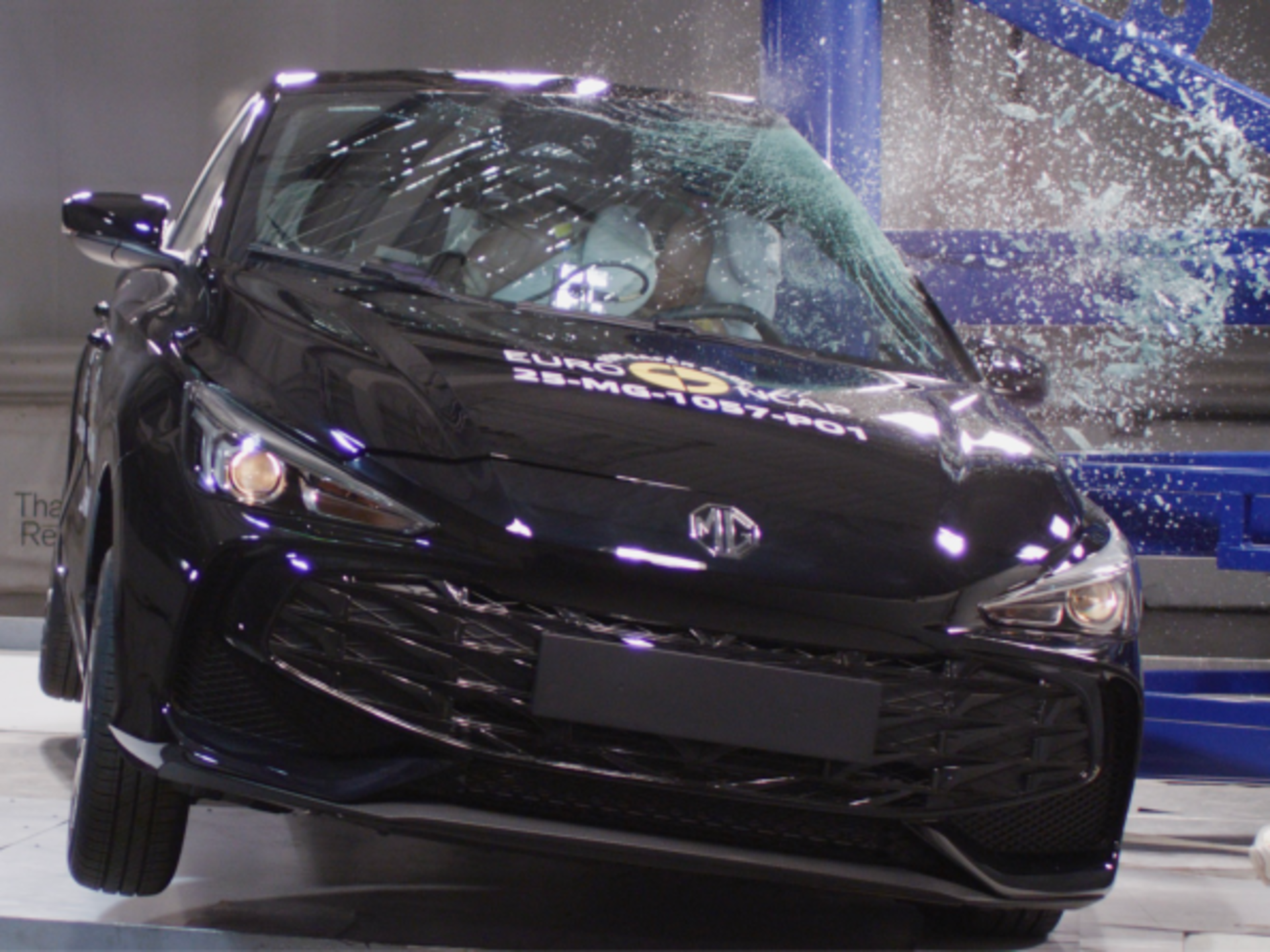
In the frontal offset test, the passenger compartment remained stable. However, two specific issues were recorded. First, there was insufficient pressure in the frontal airbag, allowing the driver's head to contact the steering wheel through the airbag at the point of maximum deformation. This is called airbag "bottoming out" and resulted in a penalty to the driver head score, which was assessed as adequate rather than good.
Second, the driver's inboard seat runner failed during the test, increasing loads on the driver's chest and upper legs. Driver chest protection was assessed as marginal, and upper leg protection was rated poor as a direct result. The front passenger scored better overall, though chest protection was marginal and upper leg protection adequate, with dashboard structures noted as a potential injury source for both occupants.
The vehicle-to-vehicle compatibility penalty was 2.06 points, meaning the MG 3 presented a moderate risk to occupants of an oncoming vehicle in this test.
In the full-width frontal test, driver protection was good across all critical body areas. However, the rear passenger's head protection was assessed as poor, due to excessive forward movement of the dummy head. Rear passenger chest protection was also marginal. These results reflect a limitation in rear seat belt performance in this specific test.
The side impact result was one of the MG 3's strengths, with the vehicle scoring the maximum available points and good protection across all critical body regions. The oblique pole test also returned strong results, with good head and pelvis protection and adequate chest protection.
MG 3 vehicles built from 30 April 2025 are equipped with a centre airbag, which provided good head protection for both front seat occupants in far-side impact testing. Whiplash protection scored 3.89 out of 4, which is a strong result.
One further note on submergence testing: it was demonstrated that the doors of the MG 3 would remain functional in water for the minimum required time period. However, window opening functionality was not demonstrated, which affected the rescue and extrication score.
The Seat Latch Failure: What it Means for Buyers
A 74% adult occupant score sits within the four-star band. The frontal offset test result was significantly influenced by two specific failures, airbag bottoming and the seat runner failure, which lowered scores for regions that may otherwise have performed better. ANCAP CEO Carla Hoorweg specifically noted the seat latch failure as "cause for caution" and called on MG to rectify the fault. The side impact and oblique pole results show the vehicle's structural protection is genuinely capable in certain collision types.
Child Occupant Protection: 75% (37.16 out of 49)
What Was Tested
Child occupant protection is assessed through dynamic crash testing using six-year-old and ten-year-old child dummies in frontal offset and side impact scenarios, as well as a practical assessment of how standard Australian and New Zealand child restraints can be installed.
What the Results Show
The MG 3 scored 75 per cent in child occupant protection. The frontal offset test results were mostly positive: protection was good for most body regions of both child dummies, though neck protection for the ten-year-old was marginal and head and neck protection for the six-year-old were adequate.
The side impact test is the area of most concern in this category. Protection of the head and chest of the ten-year-old dummy was rated poor, while protection of the six-year-old dummy was good. This discrepancy between the two dummies in the side impact test is a meaningful result for families carrying older children in the rear seat.
On the positive side, the MG 3 scored full points in the restraint installation assessment, with all assessed Australian and New Zealand child restraint types able to be installed in all rear seating positions without issue. The vehicle is fitted with ISOFix lower anchorages on both rear outboard seats and top tether anchorages across all rear seating positions.
No child presence detection (CPD) system is available on the MG 3.
Vulnerable Road User Protection: 81% (51.30 out of 63)
What Was Tested
Vulnerable road user (VRU) protection covers the physical construction of the vehicle's bonnet and windscreen and the performance of the AEB system in detecting and reacting to pedestrians, cyclists, and motorcyclists.
Physical Impact Results
The MG 3 bonnet and windscreen provided good or adequate head protection to pedestrians across most of the bonnet surface, with marginal and poor results at the stiff windscreen pillars, the rear of the bonnet, and the base of the windscreen. Lower leg protection was good across all test locations, earning maximum points. Pelvis and femur protection was mixed, ranging from marginal to good.
Autonomous Emergency Braking: Pedestrians, Cyclists, and Motorcyclists
The VRU AEB system operates from 5 km/h to 80 km/h and was assessed across a comprehensive range of real-world scenarios.
Forward pedestrian AEB performance was rated good, with collisions avoided or mitigated in most tests including turning scenarios, day and night. It is important to note that the MG 3 does not have AEB Backover capability, meaning the system does not detect or react to pedestrians when the vehicle is reversing. No points were awarded in the backover assessment. This is worth noting for families with young children in driveways and car parks.
Cyclist AEB performance was rated good, with collisions avoided or mitigated at all test speeds including in turning scenarios. The MG 3 does not provide a cyclist dooring warning.
Motorcyclist AEB performance in forward scenarios was rated good, including in turning scenarios. Emergency lane keeping performance in car-to-motorcyclist scenarios was rated adequate, which is a better result than many competitors in this class.
Safety Assist: 70% (12.64 out of 18)
What Was Tested
Safety Assist evaluates the active safety technology suite: AEB for car-to-car scenarios, lane support, speed assistance, seat belt reminders, and driver monitoring.
Car-to-Car AEB
The MG 3 AEB system operates from 5 km/h to 130 km/h in car-to-car scenarios. Testing returned good performance in standard car-to-car tests and in AEB Junction scenarios, where the vehicle can autonomously brake when turning across an oncoming vehicle. AEB Crossing performance was adequate, meaning the system is effective in some but not all crossing scenarios. AEB Head-On performance was also adequate: the system mitigated collisions in the straight-line scenario but not in the lane-change scenario, which reduced the score.
Lane Support System
The lane support system operates from 60 to 150 km/h. Lane keep assist (LKA) performance was rated good. Emergency lane keeping (ELK) performance was rated adequate in both car-to-car and car-to-motorcyclist scenarios, meaning the system provides meaningful but not maximum intervention in the most critical lane departure situations.
Speed Assistance and Driver Monitoring
The MG 3 includes a speed assistance system with speed sign recognition and an intelligent speed limiter as standard. Intelligent adaptive cruise control is not available on the MG 3, which is a difference from the MG ZS, QS, and MG4 EV Urban.
A direct driver monitoring system (DMS) detecting driver drowsiness and distraction is fitted as standard. The driver monitoring score of 0.25 out of 2 reflects that while drowsiness and distraction warnings are present, the system did not score at the level of more advanced implementations in this assessment. Seat belt reminders with occupancy detection for all seating positions scored the full 1.00 out of 1.
MG 3 Safety Features: What Comes Standard
The following safety features are standard across all MG 3 variants sold in Australia:
- Dual frontal airbags (driver and front passenger)
- Side chest-protecting airbags (front and second-row seats)
- Side head-protecting curtain airbags (front and second-row seats)
- Centre airbag (built from 30 April 2025)
- Knee airbag (driver only)
- Autonomous emergency braking: car-to-car (5-130 km/h), pedestrian (forward only), cyclist, and motorcyclist
- AEB Junction and Crossing
- AEB Head-On
- Lane keep assist (LKA) and emergency lane keeping (ELK)
- Lane departure warning (LDW)
- Forward collision warning (FCW)
- Blind spot monitoring (BSM)
- Speed sign recognition and intelligent speed limiter
- Direct driver monitoring system (drowsiness and distraction detection)
- Seat belt reminders with occupancy detection (all seating positions)
- Multi-collision braking system
- Automatic emergency call (eCall)
- ISOFix anchorages (rear outboard seats) and top tether anchorages (all rear positions)
- Rescue sheet for emergency responders
Not available on any MG 3 variant: AEB Backover, cyclist dooring alert, intelligent adaptive cruise control, child presence detection.
Which MG 3 Variants Does the Four-Star Rating Cover?
The four-star ANCAP rating applies to all of the following MG 3 variants built from 30 April 2025 onwards:
- MG 3 Vibe (1.5L petrol)
- MG 3 Excite (1.5L petrol)
- MG 3 Essence (1.5L petrol)
- MG 3 Hybrid Excite (1.5L HEV)
- MG 3 Hybrid Essence (1.5L HEV)
Important note for buyers: A three-star ANCAP rating applies to all MG 3 vehicles built prior to 30 April 2025. This includes vehicles that may have been purchased new in 2024 or early 2025. If four-star safety is a priority, confirming the build date at the point of purchase is essential. Our team at Barton Motor Group can verify this against the VIN.
View the Four-Star MG 3 at Barton Motor Group
At Barton Motor Group, we believe Queensland buyers deserve honest, complete information about the safety of every vehicle they consider. The MG 3's four-star ANCAP result represents a meaningful step forward from the previous three-star model for a light car at this price point. Buyers should be aware of ANCAP's caution around the seat latch failure noted during testing, and our team can walk you through the full detail.
For buyers looking for an affordable light car or hybrid hatchback under $35,000, the MG 3 offers a four-star rated option with a comprehensive active safety suite across all variants. Understanding the full detail of the results, including where the scores are strongest and where limitations exist, is part of making the right choice for your needs.
Visit Barton Motor Group to see the MG 3 in person, arrange a test drive, and speak with our team about which variant suits you.
Browse current stock and make an enquiry at Bartons.net.au.
Get a Deal on a New MG 3 in Brisbane and South East Queensland
Enquiry Form
MG 3 For Sale in Brisbane and South East Queensland
All safety scores, test results, and feature listings are drawn directly from the official ANCAP assessment report for the MG 3 (ZP22 series, May 2025 onwards), published September 2025. Rating applies to Australian-market variants built from 30 April 2025 (VIN LSJWP4U92SZ204415 onwards). Source: ancap.com.au.
Frequently Asked Questions
What is the ANCAP safety rating for the 2026 MG 3?
Is the MG 3 safe for families with young children?
What does the MG 3's four-star rating actually mean?
What safety features does the MG 3 come with as standard?
Where can I check the build date and test drive the four-star MG 3 in Queensland?
More Blogs For You


← Swipe →